Why do you think Americans crave war, as Sebastian Junger, producer of documentaries about war like his Oscar-nominated Restrepo, suggested in a recent story on Medium?
Promoting, Marketing and Advertising your title

Why do you think Americans crave war, as Sebastian Junger, producer of documentaries about war like his Oscar-nominated Restrepo, suggested in a recent story on Medium?
Why do you think Americans crave war, as Sebastian Junger, producer of documentaries about war like his Oscar-nominated Restrepo, suggested in a recent story on Medium?
Start that guitar solo premature
Let it rock your soul into submission
That’s right, need some stimulation
She’s hammering your head
Screaming you to shreds
Bleeding your ears like a fountain
Even when you’ve done nothing
Blow off your steam!
Not to the innocent,
But to who started it
Blow off some steam!
See that, see that wall over there?
Just try to compare,
Wait no need for wasting your time,
Cause the wall and her are no different
Try to explain to a wall a simple question
Yeah!
Blow off some steam!
Fill your mind with the heat!
Never bottle it up
Or you’ll have way too much pressure
So, right away nag for good measure
Drop dead gore, just
Shut up!
Start that guitar solo premature
Let it rock your soul into submission
That’s right, need some stimulation
She’s hammering your head
Screaming you to shreds
Bleeding your ears like a fountain
Even when you’ve done nothing
Blow off your steam!
Not to the innocent,
But to who started it
Blow off some steam!
What better way of anger management?
Just swear and yell at the one starting it
Let your cheeks turn red, and blood pressure
Climb high with each fist clincher
Blow off some steam
Believe me,
After your volcano’s erupted
You’ll feel much better about it
Now don’t we feel well rested?
(For more by Sahira Javid’s “Bitter Sweet” go to www.totalrecallpress.com or amazon.com.)
I want to be right here in Houston close to Texas Medical Center, with its 42 institutions and 15 hospitals staffed by multiple tens of thousands of medical professionals. Today with the Internet, there is most probably someone who “knows what page of the book we’re on”, whatever our malady, pain, or infection.
When I was a kid in El Paso in the ‘50s, I used to think a person felt better about a medical problem if the doctor could just put a name on it. Sometimes it seemed to me that the doctor was just “throwing darts at a board in a dark room” when he would give an elaborate name for a disease or an explanation that did not explain.
I don’t think this sort of thing happens very often these days inside the Texas Medical Center.
I remember when my oldest brother, Dr. Forrest Mosely Smith, Jr., was an aspiring pre-med who later did his residence in pediatrics at Hermann Hospital. I was selling dry ice at the time to M. D. Anderson Hospital, to Hermann Hospital, and to other med center institutions, but especially Baylor Medical School where high-powered research work required near instant freezing of human tissue at sub-zero temperatures on expiration of patients. Morgues are grim places, but I got used to several of them in T.M.C., delivering two inch thick, one foot square solid carbon dioxide slabs, often late at night or by pre-dawn’s early light.
Today our home on Rice Boulevard faces Rice Stadium and is a short mile from the Med Center. We’ve watched it grow from early days when it was referred to as Houston’s “second downtown.”
Each morning an army of thousands who’ve invested their lives in healthcare drive in to Texas Medical Center from all directions. You might say most of the Med Center employees have “enlisted in the T.M.C. healthcare army, for a lifetime.” In addition to the paid healthcare professionals there are other thousands of volunteers who don’t receive a cent for their substantial contributions to our healthcare system.
Last year Dr. Dolph Curb, a lifetime member of the South Main’s medical fellowship network passed away at age 103. This highly esteemed gentleman/physician/writer had in effect given three lifetimes of service to and/or within the Texas Medical Center.
It slightly annoys me that Houstonians have so little idea what goes on in my line of work, which is the chemical business. Is my business comparable to what goes on within Texas Medical Center? The short answer is lots. Though I jog by it almost daily, I know that far more is happening than just hospitals making sick people well. We’ve largely won the battle against heart disease and have made awesome progress against cancer and other diseases, using today’s consistently advancing medical technology.
Think for a moment of the men who founded the institutions of our Texas Medical Center and how mostly individuals paid for the hospitals within its borders out of personal funds. With the exception of Ben Taub Hospital, nearly all of our institutions arose in the private sector and with private, non-government funds. Most of the hospitals were Christian-based when they started, and hopefully some still are. Each institution’s history is a remarkable story that moves onward and upward with deliberate speed and sustained progress.
Consider Hermann Hospital. George Hermann was a bachelor Swiss immigrant who had experienced poverty and what it was like to be desperately in need of medical care but be unable to find it. When he became prosperous, he gave both Hermann Park and Hermann Hospital to the citizens of Houston. Hermann was a not-for-profit charity hospital initially when he gifted it to the citizens of Houston. His legacy is the Memorial Hermann Healthcare System, with eight satellite hospitals in the Houston area alone. My view is that George Hermann was truly the “Father Abraham” of Texas Medical Center.
Montrose D. Anderson, like George Hermann, was also a bachelor, exceptionally wealthy and frugal to an extreme. He made a fortune trading in cotton and gave us the international cancer research facility that bears his name, The M.D. Anderson Foundation.
Dr. Denton Cooley and Dr. Michael DeBakey are names familiar to most Houstonians. These men did pioneering work developing technology in fighting heart disease and cancer. Each was a general. “General” Dr. DeBakey’s “army” was at Methodist Hospital and “General” Dr. Cooley’s Texas Heart Institute “army” was at St. Luke’s Episcopal Hospital. These professional healthcare armies annually perform hundreds even thousands of open heart surgeries, cardiac cauterizations, and heart transplants.
All of us know that we are beginning to win the continuous war against cancer, heart disease, and many other diseases with spectacular victories. The “combat information center” for much of this fight is M. D. Anderson Hospital and Cancer Center, which serves not only Texans but patients from all over the world.
In my younger years whenever a person got news of cancer it was like a death sentence. Implicit in the word “cancer” was little or no hope. When you heard the diagnosis you’d silently say to yourself, “Old Schultz won’t be with us much longer.” And he wasn’t.
Then we started hearing the terms: chemotherapy, radiation treatment and in remission. People began surviving cancer and enjoying added years of life. Thankfully today, 20 years, 50 years, and near normal remaining lifetimes are not unusual, provided the cancer does not “metastasize” and they “got it all.” While one in four of us will likely die of cancer, survival rates continue rising. Five-year relative survival rates for men were in the 30% range before 1960; today here in Texas the survival rate pursuant to aggressive treatment is well over five years.
Impressive gains have also been made in reducing the cancer death rate for women, dropping 30% over 50 years. Here I salute the Susan G. Komen Breast Cancer Foundation and its annual “Race for the Cure” for breast cancer, where thousands participate in a walking, wheelchair, and jogging event in Houston. What a wonderful example of dealing with medical challenges in the private/voluntary sector.
With gratitude some thoughtful cancer persons have created the Cancer Survivors Plaza in the Texas Medical Center. It reminds me of one particularly important fact. We Texans, indeed all who have had to deal with the tough, disagreeable aspects of cancer treatment, do well to give thanks for the measurable and growing sophistication of treatments. We have lots of arrows in our quiver, whatever the type or diagnosis for cancer or heart disease. We are extending lifetimes and expectations greatly, and continuously. Increasingly persons are living to be a hundred.
Friends, you and I are standing at a crossroad that is requiring us to make some awesome life or death choices about the future of medical care. The splendid work at Texas Medical Center, as well as the sacrifices of countless volunteers, gifts of buildings, endowed chairs that cost fortunes, and heroism of healthcare volunteer armies are in danger of being trashed by the pettifogging politicians and predator lawyers in Washington, DC and Austin playpens fantasizing that they are benefactors choosing life for us, when in fact they are worse than hired thieves having a grand time choosing matters of life and death for working citizens.
Before we allow the government to choose death by default for “we the people,” let’s remember how the history of our healthcare evolved, not only at the Texas Medical Center in Houston but also throughout our nation. We want to choose life and hope, especially the Christian hope that does not disappoint us!
Bless you and thank you, doctors, medical personnel, and volunteers by the thousands!
Work and fight on, Texas Medical Center patients, phy-sicians, and your marvelous associated institutions!
Don’t give up to the pettifogging politicians and predator lawyers, especially those in Washington, DC. Here in Texas let us work and pray for a future of Heath Care that repudiates Socialized Medicine. Focus your giving and your work relative to medical progress. Keep the Faith.
(For more by David Smith and “Texas Spirit” go to www.totalrecallpress.com or amazon.com.)
Stealing
snatching at the crumbs of genius
gifted to them.
She recognizes beauty
by its glow, by a mystic
knowing
and scribbles after them
like a bird imitates its mother’s flight
as a bee feasting in a flower patch
prying out many mouthfuls.
Soon, she calls upon that hoarded cache
and her repertoire responds.
On a page a mighty thought –
built upon those juxtaposed, fragmented parts
becomes her mark.
It is fact.
(For more by Alice Shapiro’s “Life: Descending/Ascending” go to www.totalrecallpress.com or amazon.com.)
“Which one?”
“You know, the one that was so good looking. I think her first name was Burney, or somethin’ like that.”
“Oh, I know the one you mean. Her name was Brunie. Brunie Mae.”
“Yeah, that was it. She was younger than me, but we were always talkin’ about how pretty she was. I’ll bet she got her pick of the men when she got grown.”
“Well, she did for a while, but things changed after the accident and she never got married. She’s an old maid.”
“You don’t mean to tell me Brunie Mae Caldwell’s an old maid? It must have been some kind of serious accident to cause that.”
“Well, it wasn’t exactly the accident. It was more the story about the accident that done it. It was about the thunder mug.”
[Note: For the uninformed, a thunder mug is a large ceramic chamber pot. It probably got this nickname from its tendency to act as an echo chamber and amplify the sound that occurred while it was being used.]
“The thunder mug! Aw, come on. You’ve got to be pullin’ my leg on this ‘un.
“Naw I’m not. I’ll tell you what happened. One night Brunie Mae got up out of bed to use the thunder mug. The thing musta’ been cracked or somethin’, ’cause when she sat on it, it broke. Busted all over the place, I was told. Now, that should have been the end of it, but one of her brothers told one of his friends, and this friend told some¬body else and so on. You know how somethin’ like that goes. Well, somewhere along the line, somethin’ got added to the story and the story that came out of all this was that when the thunder mug busted, Brunie Mae was cut very seriously in a very strategic place. In fact, this cut was so serious that it rendered her unfit for marriage.”
“That’s amazin’. Did it really?”
“Naw, I don’t think she got cut at all, but once that story got out, nobody could get it stopped. Her brother tried to tell people it wasn’t so, but folks accused him of lyin’ for her. And you know she wasn’t goin’ to let anyone examine her. The boys quit comin’ around — even the ones who wanted to. They couldn’t stand being kidded about courtin’ ‘damaged goods.'”
“That’s really somethin’. Brunie Mae Caldwell, the prettiest girl along the Bogue Chitto. Turned into an old maid by a busted thunder mug. I swanee. I swanee.”
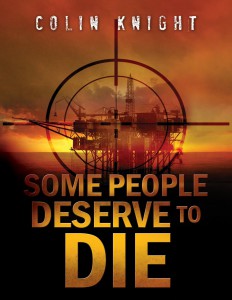
The story begins as Alan, a naive and nerdy high school boy, is plied with alcohol and drugs by four school jocks. He’s then led to an abandoned building where a girl, unconscious and naked, lies helpless in the dirt with a sack tied over her head. Encouraged, berated, and taunted, Alan reluctantly rapes the girl.
Six months after his crime, Alan’s sister, Julie, commits suicide and leaves a note that convinces Alan she had been the unknown girl in the abandoned building. Devastated and unable to face his mother, Alan runs away from home. In youthful vulnerability, he succumbs to the depravities of alcohol and drugs and enters the underworld of drug smuggling, which in turn draws him into international plots, guerrilla conflict and mercenary activities. First, to the South Pacific island paradise of Vanuatu until betrayal forces him to flee or be killed. Then to Scotland, where bad habits and competition between drug gangs threaten his life and compel him to seek safety and obscurity on a desolate North Sea oil rig. After tragedy destroys his oil rig “family,” Alan then seeks refuge in the hinterlands of Nigeria, hoping wealth, warmth, and anonymity would keep his memories away.
Twenty years later, hollowed out and dysfunctional, a chance confrontation brings Alan eye-to-eye with the four jocks who tricked him into raping his sister. Mentally bludgeoned by the encounter into reliving his crime, Alan explodes in a brief, violent rampage until his arrest places him in the care of his dead mother’s lawyer. Rehabilitated, and the sole beneficiary of his late mother’s estate, Alan finds the clarity of purpose to seek justice for his sister. But when Alan’s cruel and permanent justice has been meted out, Alan received a letter explaining the truth about his sister’s rape; a truth that forces him to recognize the true extent and consequences of his selfish self-pity and possibly accept that his form of justice had not been quite so righteous.
‘Some People Deserve to Die’ is available from Amazon.com, Barnes and Noble, Books-a-Million, and other bookstores.
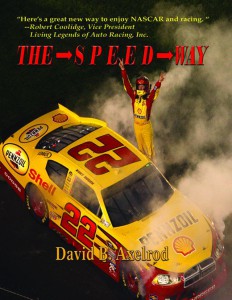
Time Trials
the steady hum of auxiliary
generators keeping the oil
warm, attached to 48 cars
stretching along the pit row,
awaiting 2 timed laps.
Singly, they start their engines,
growl, then roar out onto the track.
With this burst of energy
an order will be set, from
inside and outside pole spots
to the back of the pack.
It’s a week before the race,
a world away from a checkered
finish. First in line is Blue 2,
Brad Keselowski, racing since
he was a kid, who says his goal is,
“win anything and everything.”
But for now there’s that restrictor
plate to change; the new release
valve; which tires to use and an
infinite list of details before
speeds are measured to within
a thousandth of a second.
(For more poetry like Time Trials by David Axelrod and his book “The Speedway” go to www.totalrecallpress.com or amazon.com.)
On this particular night, I responded to a burglary call near the end of my shift; it turned out to be a good burglary, good being a relevant term, for it meant a real crime had occurred and not a false alarm.
It had been a long night. As I headed back to the Southeast Substation, westbound on Lake June Road, a six lane residential road divided by a median, I saw a very large black male standing inside the westbound lane of traffic—my lane. I thought, ”Crap, I just want to go home.” The man wasn’t watching traffic, and it was about fifteen minutes to eight on a weekday. I had to get him out of the road.
Slowing my squad car, I pulled up beside him. He had a blank stare. “Step out of the road, sir, so you don’t get hit.” The man simply nodded and stepped up on the concrete median. I continued driving, all the while knowing I needed to go back. I looked in my rear view mirror and saw him still standing on the concrete median, so I turned around and told the dispatcher to mark me out.
I stopped my car, turned on the overhead lights, and got out. This was a big man. Experience told me he was what we call “exceptional,” meaning mentally ill or challenged. Standing six feet four, he must have weighed close to three hundred pounds. Paradoxically, he looked like a lost five-year-old. He wore a long-sleeved button-down dirty shirt with a woman’s three-quarter sleeve white sweater with pastel horizontal stripes over it. The sweater would have fit my five-foot-four, one hundred seventy pound stature. He had on dirty brown Dickies pants and was barefoot.
The man carried a plastic grocery sack containing clothes and a pair of shoes. “What are you doing?” I asked.
“Waiting for a ride,” he answered.
Immediately I knew he needed help. “Do you take any medication?”
“Yes,” he said, so I asked if he had been taking it and replied he had not.
“Is anything wrong?”
His response was to reach down, un-zip his pants, and pull out his penis.
“That’s ok, you can keep that, I don’t need to see it,” I quickly responded. Thankfully, he put his penis back inside and zipped up his pants.
It was apparent he had mental difficulties, so I asked him if he wanted to go to the hospital and get some help.
“Yes,” he replied. I told him I would give him a ride to Parkland Hospital, the county hospital for our area. Since he did not appear to be a danger, I couldn’t admit him. He had to admit himself. After getting his name and birth date, I verified he didn’t have any warrants for his arrest and wasn’t a known felon. Next, I told him I would have to pat him down. No one gets in my squad car without having been searched for weapons.
He was very agreeable and didn’t hesitate to do whatever I asked. So I patted him down and placed him in the back of my car because my duty bag was in the front passenger seat. Getting back in the car, I adjusted my rear view mirror so I could see the man’s eyes. The mirror allowed me to talk to him and observe him during the trip.
I marked out at the hospital with the man in the back seat and off we went. While we were en route, I asked him some questions, trying to keep him talking, albeit just small talk, but as I watched him in the rear view mirror, I sensed he was seeing something I couldn’t see. I called his name, asking him what he was seeing.
He said, “Candy.” I thought, that’s good, at least it wasn’t demons. I sped up a little. The man started rocking while saying, “Candy canes, chocolate kisses, lollypops,” naming all kinds of candy. I sped up a little more. Then he paused and looked into the rear view mirror, into my eyes and said, “And blue candy,” as if that was the good stuff, and he smiled.
We were almost there, and I got him off the candy topic. We pulled into the parking lot of the hospital, and I walked him in through the emergency room door so he could admit himself. It was very crowded and loud. After I got him registered, I recognized he was becoming anxious. I had doubts whether this trip to the ER would work or not, so I walked him back out to the parking lot. I told him he really needed help and that I could help him, but I would have to handcuff him to take him where I could help.
He looked at me and replied, “Yes. I want help.” He placed his bag on the back of my squad car and put his hands behind his back; he looked so worn out. I walked him in through the police entrance so I could admit him for help. As he sat down, it seemed all the air went out of him. He was clearly exhausted.
While I started on the paper work, a nurse and doctor came in. The doctor was very arrogant. He spoke rudely and acted put out. Meanwhile, the man I had brought in began to rock back and forth, and as the doctor asked questions, the man became more and more agitated. He looked at me and said “I’ve already answered these questions.” I told the doctor he was upsetting the man, but the doctor replied that he had to ask the questions.
At this point, two large male nurses entered the room, causing the man to begin to talk about candy again. He rocked faster. I put down my pen and said to the doctor, “You’re pissing him off.” The two male nurses took a step back. The doctor continued. The man continued listing candies and rocking faster. Once again, I warned the doctor about the impending problem, but the doctor continued with his litany of questions.
Suddenly, a nurse in a blue uniform entered the room. The man looked at her, stopped listing candies, and then looked at me as if he had finally found it and said, “And blue candy.” As he finished the statement, and while still handcuffed, he rushed the female nurse in the blue uniform like a football player going for a tackle. The two male nurses and I dove for the man and took him to the ground. I wrapped myself around both of his legs, while each male nurse got an arm. The four of us just lay on the floor holding him down. The man barely touched the nurse because we caught him in time. Nevertheless, she screamed and ran from the room.
The doctor stood there, his mouth agape, as if to say, “What the hell?” The two male nurses and I were laughing at the situation because we saw it coming, and, of course, we were laughing at the look on the doctor’s face. Recovering, the doctor ordered the nurse to bring him a shot of Adivan and Haldol. She ran out of the room, happy to get away from her near-attacker.
While we waited for her to return with the injections, we continued to utilize our body weight to hold the behemoth down. It seemed like forever until the nurse came back. She gave the man the cocktail injection, and once it kicked in, he relaxed so much we had to drag him to a room. The first thing I told the doctor after I got up off the floor was, “I told you, you were pissing him off.”
After that incident, I never transported any “blue candy” people without cuffing them first. While the incident was somewhat funny, I also realized it could have turned out much worse.
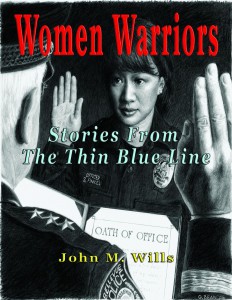
(For more stories by John Wills and “Women Warriors” go to www.totalrecallpress.com or amazon.com.)
Dress up!
Wear a jaunty corsage.
Flaunt your glittermost earrings.
Forget you’ve learned
the Octogenarian Shuffle.
You’re 90 now.
Lean on my arm—elegantly—
as if you didn’t need the help,
only as if you deserve the escort,
and you do
for the times you didn’t have one,
for the war years alone with
food rationing,
starred banners hanging
stiff in parlor windows,
and only letters for company.
You sat dry-eyed
through funerals of everyone
you loved
except your children.
First decades married to a hard man
absent too often and too long,
then these final years with a
mild-mannered gentleman lacking
tenderness and greatness of heart,
you learned the skill of freezing
tears under your skin
until they encircled your body
like rings of an ancient tree.
You build brittle bark to enclose
these ancient bonds
even as we march
through the restaurant
to your place of honor
at the flower-decked table.