
• Authors Registration
  • Login
  • ABB Book Store

AuthorBookBeat

Promoting, Marketing and Advertising your title

authorbookbeat
Be Like these authors and promote your own book signing Events
  • Home
  • About ABB
  • How ABB Works
  • FAQ
  • Services
  • Publishing
  • Literary Agents
  • Sell Books
  • Authors Index
  • Post Breaking News
  • Book Trailer
  • Interviews
  • Events
  • Short Stories
  • Press Release
  • Articles
  • Email Distribution
  • Book Reviews
  • Promote
  • Poetry
You are here: Home / Blog

Mauhad

Mauhad by M L Hollinger

Mauhad by M L Hollinger book is a very popular book.

Javik admired the brooding mountains surrounding Berglaundia, his homeland. They stood like ranks of white-haired giants standing shoulder to shoulder to protect the woods and vales below. The green fir trees climbed their slopes in a vain attempt to overwhelm their masters, and the dark
forbidding forests of oak, beech, maple, and elm spread out over the land like a protective blanket. Farmland was scarce and purchased at the price of back-breaking labor to clear the forest away.
He was thankful he was not a farmer. The cool, misty glades of tall trees called to him like a siren. It was fall, and the forest had exploded into an array of color not even rivaled by the wool dyers in his village. The woods teemed with life, and he was a hunter—a hunter learning to be a warrior. He’d lived fifteen winters, and next year he would go on Mauhad, the manhood test of his people, but now he was concentrating on finding game.
He stopped short as he spotted a slight movement in the clearing ahead. He crouched low and approached silently. A quick test showed he was down-wind of whatever made the movement. He found to cover just short of the spot and saw a doe standing in the clearing before him.

2 M. L. Hollinger
It stood deathly still while its long, broad ears scanned the dank brush for some sound of danger. Her wet, black nose twitched to extract any scent of trouble from the crisp fall air. Javik pulled the arrow slowly to full draw and raised the point to the spot where it would find his quarry’s heart. He began to relax his fingers just as the fawn rose behind its mother. A smile spread across his face as he watched the deer’s child search for a teat under the doe’s belly, and that moment of hesitation was just enough to allow the clamber of the village alarm bell to send the pair bounding off into the brush.
“The men are back from the raid,” he almost shouted as he un-noched the arrow and returned it to his quiver. The boy sped off toward his village, anticipating the celebration following a successful raid on the Sentii villages beyond the mountains.
As he entered the stockade gate, his elation quickly turned to foreboding. Everywhere he looked women wept on their mothers’ shoulders, and the wails of mourning told him many houses would be without their men tonight. He made straight for the common house where the raiders would gather, but he was not prepared for the sight greeting him there.
Wounded men lay everywhere. Their women attended to them, unwinding bloody bandages and replacing them with new dressings. In the center near the hearth fire Goldar, the raid leader, sat in a chair with two healers hovering over him.
He was bare from the waist up, and Javik could see the scars of many wounds suffered in previous raids marring his muscular torso. A fresh wound gaped on his left shoulder, and this was the subject of the healers’ attentions.
“Ahhh! Confound it, man! Quit probing and put an iron to it!” the war leader shouted, sending the healers scurrying for the brazier of hot coals holding the cauterizing irons.
Mauhad 3
Javik looked around for his father but didn’t see him. He was about to leave for his own hearth when Goldar called to him. “Javik, come here, lad.”
Javik knelt before the war leader, showing him the respect due from a lad not yet mature. “Yes, sir.”
“I’ve sad news for you.” He paused trying to find some way to deliver his terrible story more gently. In the end, he could find no better words. “Your father’s dead.”
Javik looked up at the sad face of the great man and fought back his tears. A boy who aspires to warrior status must not break down and cry even at such horrible news.
“How did he die, sir?”
At that moment the healer applied the cauterizing iron.
Goldar flinched but did not cry out. The smell of scorched flesh almost made Javik sick, but he fought the urge to vomit with what was left of his resolve. Goldar recovered quickly.
“He was leading the advance guard through the high pass when the Sentii ambushed us. They let his party through before they attacked, and Tolda could have saved himself, but he led his group back and cut an escape route through the Sentii lines for us. His action saved many lives but it cost his own. A Sentii arrow struck him down, and the last thing I saw was their war chief holding his severed head high for all to see. We had no
hope of recovering his body. I’m sorry, Javik, but your father died as he would have wished to die.”
The implications of Goldar’s words began to dawn in Javik’s mind. “What’ll I do now, sir? My mother and I have no other family. We’ll be assigned to some house as wards of the king, and I’ll have no mentor. How will I be able to complete Mauhad?”
Goldar placed one hand on Javik’s shoulder. “I’ll speak to the king. I’m sure he’ll recognize your father’s bravery. I 4 M. L. Hollinger remember something about a blood price in our ancient laws, but it hasn’t been invoked in many years. Don’t worry.
Everything will turn out well. Now, go to Dana. Your mother
needs your strength.”
Javik rose and bowed to the warrior his father respected above all other men and went directly to his mother’s hearth.
He found Dana staring into the embers with her hands folded in her lap. Swollen red eyes and the tracks of many tears clouded her beauty and she looked suddenly old.
(For more by M. L. Hollinger and “Mauhad” go to www.totalecallpress.com or www.amazon.com.)
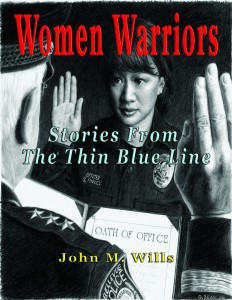
 

The Watcher

the one concerning an elderly resident who hasn’t been seen in a while. I met with the caller in front of the cottage of Emma Brown (all names have been changed to protect confidentiality), a 75-year-old divorcee who lived alone in a residential neighborhood of East Northport, Long Island. The complainant did not possess a key to the house, nor did she have any contact information for Emma’s next of kin.

The concerned neighbor took me to the side of the house. “If you look through the window, you can see her lying in bed, but she’s not moving,” she said.
Beneath a partially-drawn shade, I observed what appeared to be a person sleeping in a bed. I tapped on the window and then checked the front and back doors, but there was no response. I used my portable radio to request a supervisor.

When I heard the voice of Sergeant Lenny Smith, the epitome of a salty cop, crackle over the airwaves, I realized my regular supervisor was probably on vacation. “Whaddya got?” he asked. I was surprised he didn’t say, “Kid” at the end of that question.

“Sarge, I’ve got an apparent natural inside a residence, but it’s secure. Can I break in?”
Sergeant Smith advised, “Ten-four—with minimal damage.”
In the rear of the home, directly above the doorknob, I broke a small corner of a multi-pane window. I reached in and unlocked the door. As I entered the kitchen, I detected the pungent odor of a kitty litter box that needed changing. Brown paper bags and groceries lined the counter top, as if someone had stopped in the middle of putting them away.
I surveyed the single-story home to see if anything was amiss. I saw nothing unusual, although I did notice several cardboard boxes stacked in the living room near the front door.

As I walked into the bedroom, I anticipated a strong odor, but there wasn’t one. I leaned down and touched her neck, searching for a pulse, but her body was cold and stiff. I felt sad for this woman who had died alone in her home; I only hoped her passing in her sleep had been painless.

I returned to the neighbor who was waiting patiently outside and confirmed that she’d been right. I gathered the necessary information for my report and thanked her for looking out for her neighbor and for contacting the police.
I asked the dispatcher to contact a PA—physician’s assistant—to respond for pronouncement.

Sergeant Smith met me at the scene. The smell of cigarette smoke clung to the uniform of the bespectacled man with a comb-over. He had a leathery look about him. I wondered if I could determine the number of years he had been on the job by counting the lines on his face —sort of like checking the rings on a tree to see how old it is.

He picked up the phone in the kitchen. “I know Emma’s family,” he said, as he dialed a number.

He reached an answering machine. In his gruff voice, he said, “Yeah, Danny? This is Lenny. Your ex-wife’s dead,” and he hung up the receiver.

I tried not to reveal my stunned reaction upon hearing this inappropriate message. I figured he must know Emma’s ex-husband fairly well to leave a message like that. I had delivered several notifications before, but they were usually made in person and always with a great deal of compassion. (Of course I’ll never forget the story a New Jersey homicide detective told me. He rang the doorbell to a home in which the television was blaring. In the gentlest manner possible, he said: “I’m sorry to tell you this, but your son’s been shot and killed in a drive-by shooting.” The man’s face fell into his hands as he sobbed. However, his tears were interrupted when he heard the jingle for the lottery drawing. He whipped out the lottery tickets from his shirt pocket, spun around, and checked his numbers.)

When the PA showed up, I led him to Emma’s bedroom. It is routine, of course, to check the corpse for obvious signs of foul play. The instant he flung back the covers to expose the body—surprise!—a screeching cat sprang out. Letting out a few colorful words, we both jumped. I don’t know who was more frightened, the cat or us.

Sergeant Smith asked me to notify Emma’s sister who lived just a few miles away. “She lives above a bar in Greenlawn with a bunch of senior citizens,” he told me.
At the sister’s residence, I met several seniors who were gathered in a communal kitchen. I learned that Abigail was out but was expected to return shortly.

“Is this about her sister?” one of the female residents asked.
I paused, wondering how anyone could possibly know about Emma already. “Yes, it is,” I said, slightly puzzled.
“Oh, she already knows,” she said, as if my visit was unnecessary.
Even more confused, I insisted, “I… I… don’t think she does.”
“Well, isn’t this about her sister, Charlotte, who died last week?”
“Charlotte? Last week? I didn’t know about that sister; I’m here about another sister—Emma!”

Abigail returned shortly thereafter. I calmly broke the tragic news to the poor woman. I extended my sincerest condolences over the loss of her two dear sisters. But if I thought the surprises of the day were through, I was wrong.

After arriving home after work, I recounted the day’s events to my husband, Joe, who said, “You won’t believe this, but I delivered those boxes you saw in Emma’s living room. Her sister, Charlotte, was a long-term tenant in one of my father’s apartment buildings.”
“You’re kidding.”

“After Charlotte passed away last week, my father asked me to bring her belongings to Emma’s house. I placed them in the living room near the front door. Oh, and I know Emma’s ex-husband, Danny. He does plumbing work for my father. We knock back a couple of beers at the Laurel Saloon every now and then. He’s probably gonna need one after hearing that message today.”

As I lay awake in my own bed that night, I thought about Emma’s cat, and wondered why he’d hidden under the covers. Had he sensed that she was in trouble? Was he protecting her? Was he waiting for her to wake up? I recalled how my own childhood pet, Catsy, used to behave whenever I cried. No matter where Catsy was in the house, she’d come running. She’d affectionately, persistently, brush up against me, sensing my sorrow and comforting me. Her soothing behavior never failed to improve my mood.

In the summer of 2007, I had the privilege of attending a Memoir Writing Workshop at the Southampton Writers Conference, taught by the master himself, Frank McCourt. While the participants were gathering one morning, someone mentioned a news report about a cat that predicted patients’ deaths at a nursing home in Rhode Island.
Upon hearing this news, I shared the story of Emma Brown and her loyal cat that had hidden beneath the covers.
Frank sat at his desk, listening.
“You have to write that story,” he said.
Oscar the cat had lived on the third floor of the Steere House Nursing and Rehabilitation Center in Providence, Rhode Island. Oscar would sniff and curl up next to a patient during the last hours of the resident’s life. He correctly sensed the deaths of more than 25 residents who suffered from Alzheimer’s and Parkinson’s disease. When the staff realized the pattern, they were able to contact a patient’s family, enabling them to see their loved one before he or she passed away.

Oscar was honored with a plaque in recognition of his compassionate efforts. The animal behavior specialists interviewed for the story believed it possible that cats smell some chemical that is released before death, or that they can sense when their owner is upset or sick.

Perhaps that was why Emma’s cat was under the covers as death quietly called for Emma, and why Catsy soothed me as a child whenever I cried. This was what I also found comforting: that at the very least, Emma and I both knew the comfort of a warm and snuggling cat when we needed it most.

(For more by John Wills’ “Women Warriors: Stories from the Thin Blue Line” go to www.totalrecallpress.com or www.amazon.com.)
 

If

nothing changes
try to erase childhood.
When waiting is not enough
wait longer
until you see the cusp of death.
Divine images in a frothy cloud
spying down on two old souls
will rain an urgent welcome.

If a faultless lover fades to black
and you trudge a cobblestoned alley
alone, all pictures in your mind
dissolved like pink carnival candy,
try building a new nation.
When sparks jump off concrete walls,
inevitable resistance to change,
down a sweet Brown Betty.
Many husbands, under oaths, have warmed
to pretty perfidy.
After years nestled in wondering,
try spreading innocence.

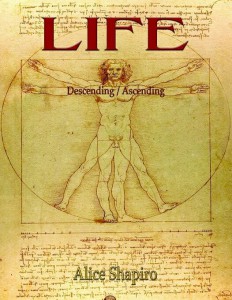
(For more by Alice Shapiro’s “Life: Descending/Ascending” go to www.totalrecallpress.com or www.amazon.com.)

 

Stepfather

Stepfather

my mother sends me down cellar to the fuse box.

He’s already at the foot of the stairs standing on a kitchen chair—one rung broken—and straining against the question-mark curve of his back.
One mottled hand clutches the door of the little gray box while
the other hand’s bony fingers flip switches.
His years and weight match: ninety-one.

The cellar bulb flashes and from upstairs
my mother’s thin voice calls, “They’re on!”

He releases the fuse box
to grasp with both hands the back of the chair
and in a series of movements
suspenseful as a slow-motion replay
bends to step down.

I lift my arm, ready to grasp his
but the force of his courage surges
like the electricity he just released
and holds me back.

He stretches a leg for the long step down,
first the right foot
finds the cement floor
then the left.
He sways, fumbles for the cane he stood up
in an empty cemetery urn,
and mutters as he thumps to the stairs,
“Don’t tell your mother.”

(For more poetry by Carlene Tejada’s “Blue Pears” go to www.totalrecallpress.com.)


Locomotives, Bells, and Collections

that I bought from Jefferson Lake Sulfur Company when they closed their Starks, Louisiana works. At the time I was something of a chemical junk man.
Now as a junk man in just about any field, you “don’t get no respect.” Furthermore, if you have David Smith as your baptismal name you get even less, since upon first meeting people might think it’s a name of convenience, since there are near 10,000 David Smiths in the United States.

My locomotive turned out to be the first of several fun hobbies I’ve enjoyed over my lifetime, though it nearly broke us at a time when our family finances were fragile. I find hobbies most fascinating. They can become addictive as one hobby leads to another, and still another until you run out or space to keep them, run out of money to buy more of them, run into another interesting hobby, run out of interest, or die.

A good hobby should surely be something of an adventure, so like all adventures it entails some risk. My hobbies almost always translate “collection.” I’ve collected a pretty good number of things including books, especially Sam Houston books, also dimes, quarters, nutcrackers, Texiana, and elaborate contraptions including domino shufflers, but STOP!
Pardon me if I put on my Uncle Davo hat for a moment. I call this my Dutch Uncle, which I’m apt to put on with younger kinfolks.

WARNING, COLLECTORS ALL:
1. Don’t let your hobby, collection or whatever it might be damage the family budget.
2. If you’re going into collecting, pick something that has a definable, comprehensible universe ─ surely not bottle caps, postage stamps, foreign currency, or rocks. With collections of large numbers, you’re apt to be like the cowboy who got up in the morning and tried to ride off in all directions thinking surely if he rode fast enough and hard enough, he’d get everywhere by sunset. Had I been born a generation earlier, I might have been that cowboy.

3. If you go into collecting something thinking it can be both hobby and business, you’re probably making a mistake. A football player simply cannot run for two goals at the same time nor play for two teams in the same game.

4. If as a kid you suffered from A.D.D. (attention deficit disorders), unless you’re cured, watch out! You’re headed for trouble. I’m warning myself when I say this.

I never intended to collect locomotives, though for almost a year I had two of them. Since it takes two of anything to start a collection, please understand that I owned only one locomotive, never two. Let’s agree on the stipulation that I had half a locomotive collection. I’ll plead guilty to this lesser offense. The advantage of collecting locomotives is that risk of theft is low. In contrast to books, there’s little chance with a locomotive that someone will borrow it one day and fail to return it.

Looking back to the 1960s it might be better expressed that instead of a midlife crisis, I had an infatuation with a huge, crude, ugly, loathsome, overweight, inanimate, iron, seventy-five ton diesel locomotive. Here’s how it all happened.

One day in the spring of 1964 I arrived in Starks, Louisiana to buy the Jefferson Lake Sulfur Company’s low-grade sulfur remnants, billing myself as a “Buyer and Broker of Chemical Materials.” Their agent, Mr. Thibodaux, was a Cajun gentleman, and we became friends quickly on a first-name basis. He called me Smeety, and I called him Tibby, but we were at an impasse on the value of his junk sulfur. As I headed for the door he stopped me, almost as an afterthought.

“Smeety,” he said, “you like to buy a locomotive? I got one I sell you real cheep,” adding, “I make you price you cannot refuse.”

Tibby had punched my hot button. In another day we were near closing, since one of my hobbies had been checking out several still extant Texas railroads in the 1960s. There is but one step in the collecting game from collecting one or two locomotives to collecting bells, since every operating locomotive must have a bell. Let me tell you what great fun I’ve had with locomotive bells, especially collecting large bells. Bells are another agenda.
In my single days I visited nearly all of the remaining steam lines in Texas, railroads with such grand-sounding names as “The Angelina County and Neches River Railroad,” “The Moscow, Camden, and San Augustine Railroad” and grandest of them all, then still in receivership, “The Waco, Beaumont, Trinity and Sabine Railway,” which had the distinction of not getting to any of the four places in its ambitious name. It didn’t get to Waco, it never reached Beaumont, it came close to the Trinity River but missed, and it missed the Sabine River by fifty miles. From the receiver of the WBT&S, I was able to buy a detached locomotive bell, which started my big bell collection that today numbers over twenty.
My half locomotive bell collection led to a happy adjunct hobby that started when my folks visited us at our mini-farm in Dayton, Texas, and Dad saw my bell from a narrow gauge sugar mill locomotive.

“Davo, that’s sure a fine looking bell,” Dad remarked. “Do you think there’s some way you could get me one just like it for Live Oak Ranch by Christmas?”

I had but few opportunities to express thanks to our great Dad Smith during his lifetime other than give him a tie or a pair of sox on Father’s Day. His gifts to us three boys were frequent and appreciated. But here was something Dad manifestly wanted very much, and my answer was easy coming: “Sure, Dad, I’ll get you a bell like this one, and it’ll be my Christmas present to you.” It was spring at the time.

I hunted high and low for another small narrow gauge locomotive bell, like mine off the Jefferson Lake Sulfur plant switch engine. I thought it would be easily possible to find, but it didn’t work out that way. There were plenty of so-called farm bells made of iron and sold from “Sears’s catalogs” but they lacked a lot in sound compared to mine from bronze bell makers.

At midsummer I was getting nowhere. Then a question popped into my mind one day, “I wonder if I might make a replica of my bell for Dad by Christmas?”

I located a foundryman named Skyvara who sent me to a Mr. Grimes of General Pattern Works who informed me, “Son, you can just as well make several bells as one, for you’re going to have quite an investment sunk in this project before it’s over.”

I found a helpful consultant on metallurgy through the American Bell Association, a Vice President of Gould Pump Company who explained that I needed a high tin content bronze for a loud sustained ring on any large bell.

I had some thinking and deciding to do, and also some praying. We were coming into fall and my word was out. I could of course give Dad my original bell as a backup, but that would be as empty as kissing your sister.

Fortunately, as a chemical junk man, I had just made a handsome profit on a nickel carbonate trade at Humble Oil that could pay for casting five bells. Then I had the idea to run an ad in the Wall Street Journal and hopefully sell some bells to help cover the cost of one made for Dad, as suggested by Mr. Grimes.

I learned by doing, albeit slowly. In any case I concentrated on bells ahead of chemicals until the castings were made late in the fall. Then in December I did the grinding, lathing, drilling, polishing, assembling, often crudely and clumsily, but by myself. Finally and proudly I took my first finished bell to Live Oak Ranch on Christmas Eve of 1963, a bell that worked well and had a right, loud, sustained tone when Dad rang it:

C L A N G!!!!!!!!!!!!!!!!!!!!!!!

I can hear it now in my mind’s ear. More important, Dad was supremely happy and mounted it on a cedar post and you can ring it today if you come in the side door of our house at Live Oak Ranch, near Bergheim, Texas.
* * * * *
Having half a locomotive collection for three years also led me to a man who dealt in old steam engines, a Mr. Waldo Bugbee in San Antonio. Now Mr. Bugbee bought old steam engines over the U.S., first for their large bells, but also for export into Mexico or to become scrap which was literally “the last stop on the train.”

Mr. Bugbee also never became too fond of his items, locomotives or bells, as I was inclined to do. A collector trader must be detached professionally, especially when collecting animals. If your business should become a collection of pets, watch out! You’re in deep trouble.

Several large bells in my collection came from Mr. Bugbee, mostly off engines of the “Louisville and Nashville Railroad.” When my boys were in Boy Scouts at South Main Baptist Church, we mounted several of my locomotive bells on a structure of bridge timbers so that Troop 27 at South Main Baptist Church could take part in a Fourth of July symphony performance at Hermann Park. In that finale of Tchaikovsky’s 1812 Overture where cannons and church bells celebrate the liberation of Moscow, fireworks substituted for the cannons and our locomotive bells, vigorously manned by Ralph Mills’ Boy Scout Troup, well expressed the spirit of freedom. It was loud and it was glorious!
* * * * *
But let’s go back to that day in 1964 at Starks, La., when Tibby punched my hot button that started my half locomotive collection. To some extent I was “throwing darts at a board in a dark room.” I did have moderate knowledge of Texas railroad history, just enough to be dangerous. And when Tibby invited me up in the cab and we proceeded to start that grand sounding massive diesel engine, I was excited. When Tibby showed me how to engage the massive clutch and we moved down the track, I was beyond redemption.
Without a muffler, the engine roared louder than a Sherman tank—so loud in fact that neither of us could hear the other. We went down the line maybe a mile or two, stopped, put the locomotive in reverse and backed back to the plant, the diesel roaring loud.
Two weeks later I had done more homework and located an equipment dealer who sold Jefferson Lake Sulfur Company that locomotive in the first place. It was Mr. Earl Calkins of Mustang Tractor and Equipment Company of Houston, an acquaintance who became a friend, then a mentor, also a consultant, even an angel. Mr. Calkins offered to line up financing for me with CIT Financial in Chicago, and in that regard he was also a teacher. I was greatly flattered when he volunteered to go on my term note to buy Tibby’s locomotive.

Ultimately I closed the deal with Tibby when we got together on the price for his junk sulfur. I sold it to boyhood farmer friends, the Stahmanns, in Las Cruces, New Mexico who put it around their pecan trees. Things were going fairly well in my emerging chemical junk business.
* * * * *
What I didn’t know was how long it would take for me to sell the locomotive, or as Charis came to call it, “the albatross.” Weeks turned into months, and soon we entered the third year of my having a locomotive “half collection.” Ads in used equipment magazines produced few leads. It didn’t take long for Charis to note my fascination with the locomotive had turned around 180 degrees. Soon I loathed my locomotive, and Charis liked it even less.

Because we were buying a locomotive, we could not afford a better car. When the chemical junk business was punk, I would have to look to Charis to make the monthly payments to CIT Commercial Finance (with interest north of 14%) out of her skinny teacher’s salary from Elliott Elementary School. Asking Charis to make the monthly locomotive payment was becoming an embarrassing monthly ritual.

(For more by David Smith’s “Texas Spirit” go to www.totalrecallpress.com or www.amazon.com.)

 

THE POLITICS OF ETHANOL

Let’s burn food for fuel.
We have too many hungry
people. Some can starve —
economic survival of the fittest.

Turn corn into ethanol.
Push food prices up.
Pay no attention to that
man behind the screen
or all the studies that say
even large-scale production
isn’t cost or energy efficient.

It isn’t lack of oil forcing
us toward biofuel. It’s
too much of it — too much
oil-industry power distracting
us from better batteries,
solar chargers, cheap,
powerful electric cars.

Don’t get me started on
the lack of good mass transit

(For more by David Axelrod’s “The Speed Way” go to www.totalrecallpress.com or www.amazon.com.)
 

Doc Smith

Luke Boyd

In addition to these regular rounds, he was subject to being summoned for emergencies. Since there were no phones in the country, somebody had to come and get him when he was needed to deliver a baby or treat an injury. Doc Smith delivered both my brother and me at home. There was another time when Daddy had to go get him to put me back together. To this day I’m grateful that he was as good a doctor as he was.

We were living on a new-ground farm back in a low part of the Delta toward the river. Because water would cover the land ever so often, our house was built up on pilings about four or five feet off the ground. I was two years old and some months. I don’t know just how many. I know that we are not supposed to have memories of things that happen when we’re that young, but the incident is still vivid in my mind. I don’t remember anything that happened after it but I do remember the fall. I was going up our front steps and something behind me–perhaps a noise, a call, a dog barking–caught my attention. I looked back over my left shoulder but kept on walking up the steps veering to the right as I walked. A step or so from the top I stepped out into space. As I fell, I instinctively threw my right arm out to break my fall. I landed with all my weight on that arm. The elbow splintered, bones came out of the skin and stuck in the soft earth. I remember crying, but I don’t remember the pain. Daddy picked me up and sat me up on the porch. Mama came running up and I heard Daddy say, “It’s broke. I’ll go get Doc.” Beyond that, everything about the incident is blank.

Daddy brought Doc back with him and they laid me on the kitchen table. Mama held chloroform to my nose while Daddy assisted Doc. Without the help of x-rays, pins, wires, screws, or all the other things orthopedic surgeons consider indispensable today, Doc Smith took his hands and pushed the broken pieces around until he got them lined up where he thought they should be. He sterilized the gashes where the bones came out, sewed them up, and put on a splint.

When the splint came off, everything seemed to work fine, but my arm was a little crooked. Instead of angling away from my body my forearm angled in. My parents decided to let well enough alone and not attempt any further fixing. Time has proven that decision to be correct. I’ve thrown just about every kind of ball there is with it and done every kind of lifting and never had a problem, except for having to try to explain to a whole bunch of Army doctors that it really did function. One flatly told me even after I bent it every possible way that any elbow put together that way could not work.

Today, more than sixty years later, when I think about what Doc Smith did that day on that kitchen table, I’m truly amazed. I wonder how many of our modern physicians could duplicate that feat.

(For more by Luke Boyd and “Coon Dogs and Outhouses V1” go to www.totalrecallpress.com or www.amazon.com.)


Run, Cissy, Run

Run Cissy Run by Betty J Vaughn

Run Cissy Run by Betty J Vaughn book is a very popular book.

You would think Cecilia LaRoque has it all: a loving father, wealth, beauty, social position and a devoted suitor. She doesn’t. Crushed by a cold and critical mother who soon absconds to live with a dissolute lover, ‘Cissy’ struggles to prove herself worthy of love and respect. She could not have foreseen in her teenage years that the genteel and privileged life she had led would come to a crashing halt with the outbreak of Civil War, a bitter struggle that would tear her world apart. Despite the hardships, she seizes the opportunity to forge an unorthodox role for herself as a spy.

The reader feels the pain of hunger, fear, and deprivation that looms like a dark cloud over the landscape as neighbor struggles to help neighbor during desperate times.
The La Roque family is a focal point of the story. Graham LaRoque, a wealthy shipping magnate, is abandoned by a wife who is incapable of love, and left to raise his young daughter, Cissy, alone. Over time, Cissy grows from a young daughter to a young woman. Because of her father’s prominence, Cissy must be on guard for suitors of questionable character, who would marry her for her wealth. As a high-spirited young woman seeking adventure, she rebels against the status quo of women who were expected to remain in the background as she becomes a spy for the Confederate cause.
By the end of the book, the reader has traveled back in time, vicariously experiencing the life of eastern North Carolinians, who lived and loved, who struggled to survive, and who, in the light of dawn, looked to a brighter day.

Publication date: 04 Aug 2015

Publisher: Totalrecall Publications


Germany

voracious thirst for other’s doubt,
transformation, mending.
Music scatters airwaves to flow straight
to swayable ears, serenely accepting
the jazz of it, the drift.
Meanwhile Baden-Baden’s roulette wheels
spiced an evening,
and plush carpet silenced reason.
That was then,
pretending we could slide unannounced
through royalty, like gods drunk on fake celebrity.
It is a drip from a faucet
interrupting a lonely night dressed with
half-read volumes and honky-tonk.
Sweet sentiments, dead-quiet room
mixed like a good cocktail in a trembling hand.

(For more poetry by Alice Shapiro and “Life: Descending/Ascending” go to www.totalrecallpress.com or www.amazon.com.)


One Good Shot

It was a Sunday, but my “Friday,” which was typically a good thing after a long week on the evening shift. I worked the 38th district, a fairly rural and quiet part of the city back then. If things went as planned, I would stop a few cars, respond on a minor disturbance, work an accident or two, and be back at the station by 10:50 p.m. By 11:05 p.m., I would be on my way home.

I hadn’t been out of the field training program and on my own for more than a month. I was a rookie in every sense of the word, but hoping not to let it show. That is, until the call came out.

“Unit 338, respond to an injured deer at 83 and Mize. The callers are standing by.”
There it was, the call I was dreading—an injured animal. I would be responsible for taking care of it, a euphemism for euthanizing the deer. Oh, and with an audience. Perfect. Let me preface this story by saying I am not a hunter. In fact, I spent the first week of firearms training with duct tape over one eye of my shooting glasses, after being labeled “right handed, but left eye dominant.” I realized how absolutely ridiculous I looked to everyone around me, especially the firearms instructor who came up with that helpful tape idea. I know duct tape can fix just about anything, but that was a stretch. I am certain he thought that would be the last of me at his gun range. I admit I was terrified when I realized that I needed to build up that eye muscle and learn to shoot without the tape. I surprised quite a few people when I mastered it and became a pretty good shot. In fact, I began to enjoy shooting as long as live critters weren’t my target.

Regardless, I always knew the day would come when I would have to shoot an animal, so I reluctantly put my car in drive and headed west towards Bambi. I hadn’t made it a mile before an officer jumped on the radio offering to handle the call for me. I am sure there were a variety of reasons for his offer, the last one being genuine concern for my psychological well-being. I figured out, early on, that my male counterparts liked to have any excuse to shoot at anything.

I politely declined his offer because I refused to let anyone else handle a call that was my responsibility. I also knew I had to prove myself as a new, female officer, but that didn’t stop me from frantically typing a message on my laptop computer to the 35 district officer. This particular officer was a seasoned cop, but I knew he wouldn’t make fun of me because he was new to my department. At least, we still had the capability of using instant messaging. I was grateful for that. It allowed me to send a covert message without anyone hearing it or, hopefully, knowing about it afterwards. My message was simple: “Hey, what’s the best way to kill a deer?”

His response was equally as simple: “A shot to the base of the neck. One, if you’re good.”
My sergeant at the time overheard the radio traffic and realized I was on my way to discharge a firearm within the city limits for the first time. He was responding with a deer tag to claim the animal for some lucky citizen. I wasn’t a big fan of the deer tag program because it ensured a crowd would be standing by anxiously awaiting my arrival. There’s nothing quite like an audience witnessing a first time of anything, much less my execution of some helpless creature.

Upon arrival, I pulled to the side of the two-lane road, and parked behind a couple of trucks and a car. I hadn’t even made it out of my vehicle before being flagged down. Little did I know, the first person to greet me would be a District Court judge—and an unpopular one at that. I also had no idea he was an animal activist of sorts, who was horrified that someone struck a deer and didn’t stop to render life-saving treatment. Remember, it was a Sunday night with frigid temps and icy roads. And there was a judge asking me what animal rescue center I would be transporting the deer to. Of course, he had to mention that he was a Lenexa resident and taxpayer, as if I should thank him for my last pay raise.
At first, I thought someone was playing a really bad joke on me. After all, did it look like I was prepared to load a deer into the back seat of my car? Moreover, did I look trained to triage Bambi until I could find someone experienced in deer rehabilitation? I am fairly confident the expression on my face said it all before I even opened my mouth. I am also sure that moment sealed my fate for future trials in that judge’s court, but that is a story for another day.

There I was, a newly trained officer, worried about taking the deer out with one good shot, and a judge demanding that I do SOMETHING immediately to save the animal. Meanwhile, my sergeant was miles from my location with that ever-popular deer tag.
To give you a better appreciation for my stress level, I had the kind of snot running down my face that freezes before you can do anything about it. All the while I’m trying to explain tactfully that a rescue mission wasn’t in order and fielding questions about whether or not Bubba could “dress” the deer right there on the side of the road. At that point, I didn’t even think I would be able to wrap my frozen finger around the trigger, and I couldn’t figure out why Bubba was using the word dress in the same sentence with deer.
It felt like time was frozen just like the surrounding landscape as I waited for permission to destroy the deer. The poor thing was trying to stand and run off, all to no avail. He slowly slid down the snow-packed embankment and onto the edge of the road.

I knew what had to be done, so I got on the radio and let my sergeant know it was time. Fortunately, the judge decided my cruel and unusual punishment of doing nothing was far too much for him to bear, so he left. Bubba and another guy were on my heels, hoping for that prized deer tag like it was the state lottery. An antsy child meant one guy couldn’t stick around any longer, so that left Bubba as the last man standing. I promised him I would hold the tag, so he could drive a mile or so down the road for his hunting truck, which I didn’t fully understand until I saw the big chain and hook attached to the bed.
I had a small window of time and needed to move quickly, before my audience returned.
As I began my approach, Bambi locked eyes with me. Her injuries were severe, but limited to her legs. That meant she was well aware something bad was about to happen. Unfortunately, I had a real problem with the persistent eye-contact. I had to formulate a plan and fast. I drew my duty weapon and kept it by my side, as if that would ease the animal’s fear of the unknown. I wasn’t able to get in position because she could turn her head darn-near all the way behind her. Like I said, I had a real problem with the whole eye-contact thing, and I didn’t have the heart to pull the trigger with those big, brown eyes staring back at me.

I began running circles around Bambi, slipping and sliding on the icy ground, trying to disorient her. Finally, I was out of breath, and she was too dizzy to find my face. She looked straight ahead, and I tip-toed up behind her. Then it was over, with one well-placed shot, just in time for Bubba’s return. I was actually pretty proud of my tactics when it was all said and done.

Afterward, I sat in my car, took a deep breath, and went back in service. A minute later, I received a follow-up message on my laptop asking how many times I had to shoot Bambi. “Just once,” I told him. His response was, “Really? I was only kidding. It usually takes me two or three shots.” My comment back to him: “Guess I am just a good shot.”

I admit, I am still not a hunter but I have put my fair share of unfortunate creatures out of their misery since that day. While I may have devised some down-right hilarious tactics to get the job done, it always ended with one good shot.

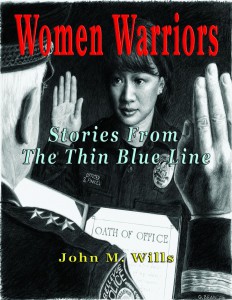
(For more by John Wills’ “Women Warriors: Stories from the Thin Blue Line” go to www.totalrecallpress.com or www.amazon.com.)


  • « Previous Page
  • 1
  • …
  • 22
  • 23
  • 24
  • 25
  • 26
  • …
  • 56
  • Next Page »

Copyright © 2025 · www.AuthorBookBeat.com | Privacy Policy | Terms of Service